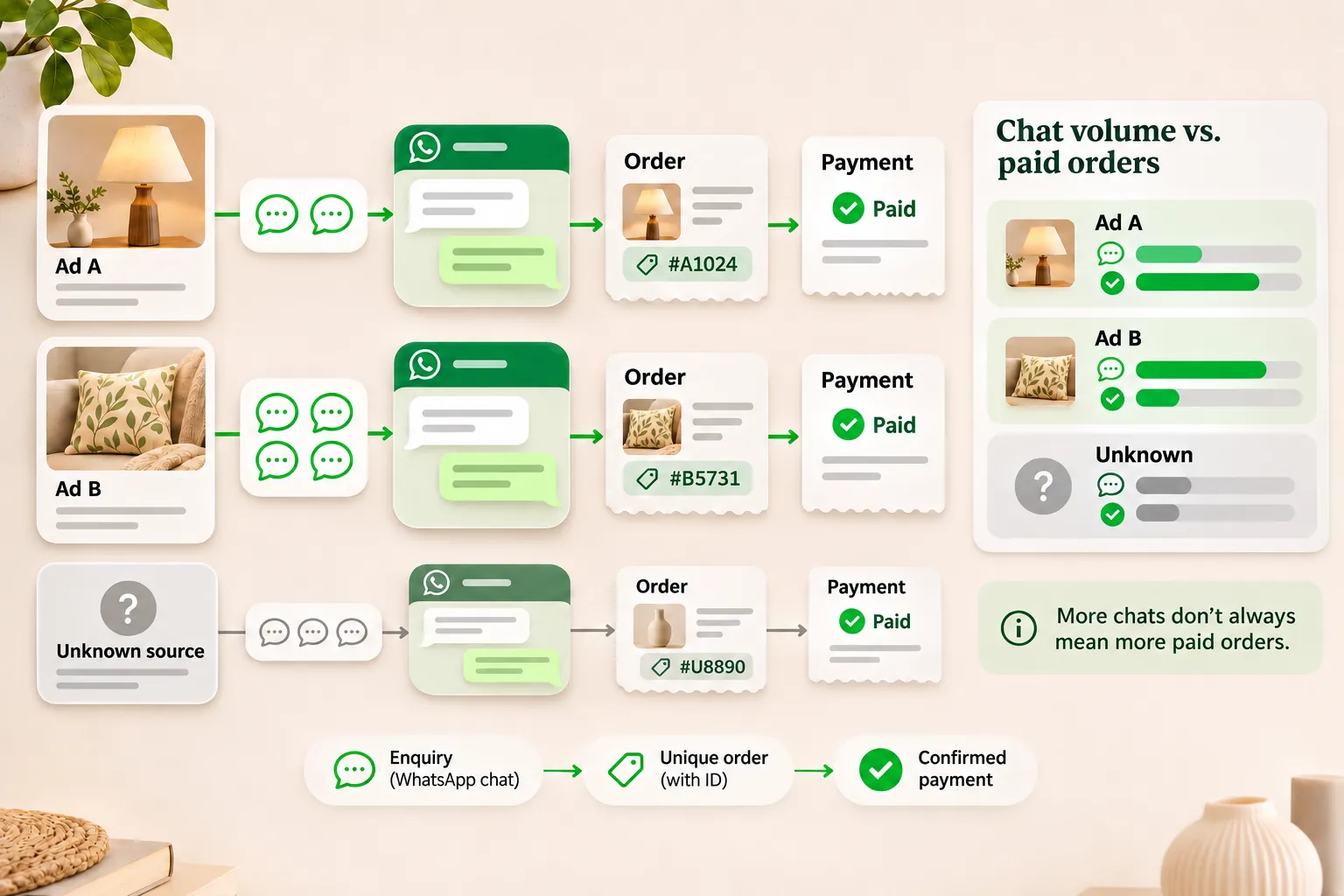
Quick answer: Record the source of each WhatsApp enquiry, give every order a unique ID, and reconcile that order with a confirmed payment. Compare ads using the same reporting period and attribution rule. Keep unknown sources visible. This produces an operational attribution report, not proof that an ad caused every sale.
A click, a conversation, an order and a payment are different events. Losing the connection between them makes it easy to reward the ad that starts the most chats instead of the one associated with the most paid orders.
Disclosure: We build WeNext.ai, a WhatsApp CRM and automation platform. The manual method below also works with a spreadsheet. Product features and integrations should be checked in your account.
What do Click-to-WhatsApp ads measure?
Ads that click to WhatsApplet people open a conversation with a business. Ads Manager can report ad performance and messaging results, depending on the setup and selected metrics. A messaging result should not be treated as a paid order.
Your team still needs to record what happened after the enquiry: whether a quote was accepted, an order was created, payment was confirmed, or a refund followed. A sale written in a notebook does not automatically become a purchase event in Ads Manager.
Which attribution rule should a small business use?
Choose one simple rule and write it at the top of the report. For example: assign a first order to the recorded source of the enquiry that led to it, within a defined reporting window. Keep that source unchanged when later messages arrive, unless you are correcting an evidenced mistake.
Key pointThis is a business reporting convention. It can differ from Meta’s attribution settings, and it does not capture every influence on the purchase.
A customer might see several ads, hear about you from a friend and return directly before paying.
Keep separate fields for the recorded source, the evidence and the confidence of the match. A webhook referral, an ad-specific starting message and a customer’s recollection are different kinds of evidence. Do not silently treat them as equally reliable.
How do you connect an ad to a WhatsApp enquiry?
- Give each ad a short source code. Keep a mapping between that code and the exact campaign, ad set and ad IDs. Names can change, so preserve stable IDs where available.
- Use a distinct starting message where supported. For example, “Hi, I am asking about the lamp gift offer, code L1.” A message can be edited or shared, so the code is a useful clue rather than an infallible identifier.
- Record the source when the enquiry arrives. Use available labels, lists or CRM fields and keep a durable source record. Do not erase historical mappings when an ad stops.
- Keep an unknown category. If the evidence is missing, ask one neutral question about how the person found you. Record their answer as self-reported, or leave the source unknown.
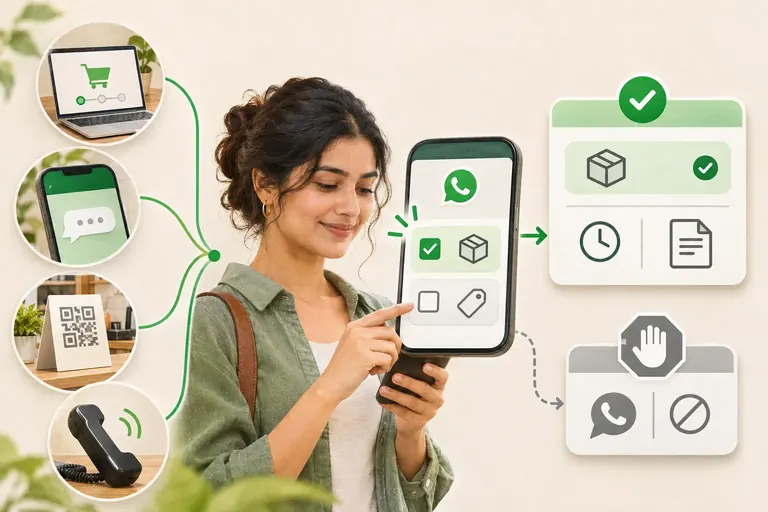
For a website or bio link, aWhatsApp click-to-chat linkcan include a pre-filled message. Track that source separately from paid ads. Do not place personal data, credentials or payment details in a tracking URL.
On the Business Platform, supported ad-origin messages can contain referral metadata that software can use for matching. Whether a particular field is present depends on the message and integration. Store only what is needed, and test real permitted examples before promising automatic coverage for every enquiry.
How do you connect the enquiry to an order and payment?
Create a unique order ID independently of the source code. Store the ad source in a separate field. This avoids changing an order ID if you later correct attribution, and accommodates repeat buyers and multiple orders from one chat.
Use the same order ID in your internal order record, the customer confirmation and the payment reference where your provider supports it. An example order reference is ORD-20261110-007; its source can be L1 in a separate column.
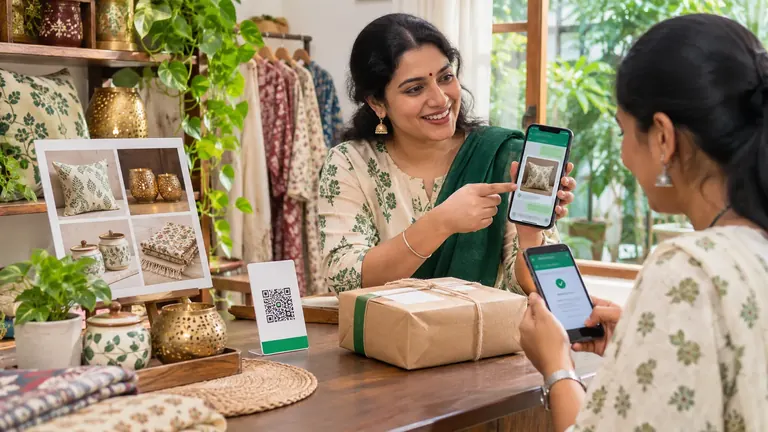
A payment link or screenshot is not proof of payment. Confirm the actual payment in your provider dashboard or bank records and match it to the order. Keep pending, failed, refunded, partially paid and paid states separate. For cash on delivery, do not treat dispatch as cash received; record collection and remittance using your accounting process.
A useful tracking record has these fields:
Tracking record
Enquiry ID and date; minimal customer reference.
Recorded source, ad ID if known, evidence type and attribution rule.
Order ID, order date, order value and status.
Payment status, confirmed amount and confirmation date.
Refund or cancellation amount and date.
Responsible teammate and necessary operational notes.
Use access controls and a retention period appropriate to the business. Avoid filling a shared spreadsheet with full chats, identity documents, health details or unnecessary personal information.
How can a lower cost per chat hide weaker sales?
Illustrative calculation, not a WeNext customer result: Two ads each spend INR 1,000. Ad L1 produces 40 recorded new chats and seven paid orders. Ad L2 produces 70 new chats and three paid orders. For this simplified example, each paid order belongs to one distinct chat, and the observation period is the same.
- L1: Cost per chat = INR 1,000 / 40 = INR 25. Cost per paid order = INR 1,000 / 7 = about INR 142.86. Chat-to-paid-order rate = 7 / 40 = 17.5%.
- L2: Cost per chat = INR 1,000 / 70 = about INR 14.29. Cost per paid order = INR 1,000 / 3 = about INR 333.33. Chat-to-paid-order rate = 3 / 70 = about 4.29%.
L2 has cheaper chats, while L1 has a lower observed cost per paid order in this small example. That alone does not establish higher profit or a reliable long-term winner. Compare order value, margins, refunds, fulfilment costs, lead quality and sample size before changing budgets.
Which numbers belong in the weekly report?
For each source, report spend, distinct recorded enquiries, paid orders, collected revenue, refunds, net collected revenue and unknown or unmatched records. Define what counts as an enquiry and a paid order before comparing periods.
- Cost per recorded enquiry: ad spend divided by recorded enquiries.
- Cost per paid order: ad spend divided by paid orders.
- Recorded revenue-to-ad-spend ratio: attributed revenue divided by ad spend, using a clearly stated gross or net revenue basis.
Use “not available” when a denominator is zero rather than inventing a ratio. Keep repeated orders and multiple chats from the same person from inflating conversion rates.
Group leads by the period in which they arrived, then allow time for the normal sales cycle. Update late payments and refunds in that original cohort. Also keep a separate payment-date view for cash reporting. Do not compare this week’s spend with unrelated receipts collected this week and call it ad performance.
Should you send purchase events back to Meta?
You do not need to send customer data to Meta to keep an internal attribution report. If your setup supports it, Meta’sConversions API for Business Messagingcan support event reporting for ad measurement. Eligibility, supported events, identifiers and implementation requirements must be checked against current documentation and your provider.
Before enabling an integration, verify the lawful basis and required notices or permissions, Meta’s applicable data terms, permitted fields, retention and access controls. Do not send sensitive customer details or raw conversations just because a connector has an upload field. Hashing an identifier does not remove privacy obligations.
Validate event matching, duplicate prevention, cancellations and refunds with your technical team. An incorrect order record becomes an incorrect conversion event if it is sent upstream.
Where can WeNext help?
WeNext.ai offers WhatsApp CRM and automation workflows. To assess it for attribution, compare the current feature list, supported integrations and plans with your requirements.
Ask whether your chosen configuration preserves ad-source evidence, links orders to confirmed payments, handles refunds, exports a usable report and records unknown sources. Test those steps in your account. Do not assume that all payment gateways, attribution fields or reporting features are available on every plan.
Frequently asked questions
Can I do this with the WhatsApp Business app?
Yes, as a manual process using source codes, available chat organization features and a spreadsheet. Coverage depends on the evidence you capture; some sources will remain unknown.
Why does my report differ from Ads Manager?
Possible reasons include different attribution rules, reporting windows, time zones, duplicate definitions, missing source data and late payments or refunds. Reconcile the definitions before concluding that one report is wrong.
Does attribution prove the ad caused the sale?
No. Attribution assigns credit using a rule and available data. Measuring incremental impact usually requires a suitable experiment or other careful analysis.
How long should I wait before judging an ad?
Allow for your normal sales cycle and enough observations to make a useful comparison. A week can be a reporting cadence, but it is not a universal test duration. Avoid large budget decisions based on only a few conversions.
Start with one source-to-payment check
Pick a recent paid order. Can you find its original enquiry, source evidence, order record and payment confirmation? If one link is missing, fix that step before expanding the report or automating event uploads.
For the full journey from first enquiry to paid order, read our guide on how to sell on WhatsApp in India.