
.svg)

WeNext.ai
7 out of 10 Indian online shoppers add something to a cart and leave without buying.
That is not a product problem. That is not a traffic problem. It is a follow-up problem — and it is costing Indian D2C brands crores of rupees in recoverable revenue every single month.
The brands fixing this fastest in 2026 are not relying on email. They are using WhatsApp — where messages are read within 3 minutes of delivery and a payment link is one tap away. And they are doing it automatically, through WeNext.
WeNext customers recover 35–45% of their abandoned cart value on average. This guide explains exactly how.
Email cart recovery open rates in India sit between 15–25%. WhatsApp open rates consistently exceed 90%.
Indian customers check WhatsApp constantly — it is the app they use to talk to people they trust. A well-crafted message from a brand on WhatsApp feels personal and immediate. A promotional email feels like noise.
There is also the purchase journey to consider. Most Indian D2C customers browse on mobile. Completing a purchase via a payment link inside WhatsApp — without navigating back to a website, finding the cart, and re-entering payment details — removes enormous friction from the conversion path.
WeNext combines both advantages: messages that get read, and a payment experience that removes every barrier between interest and purchase.
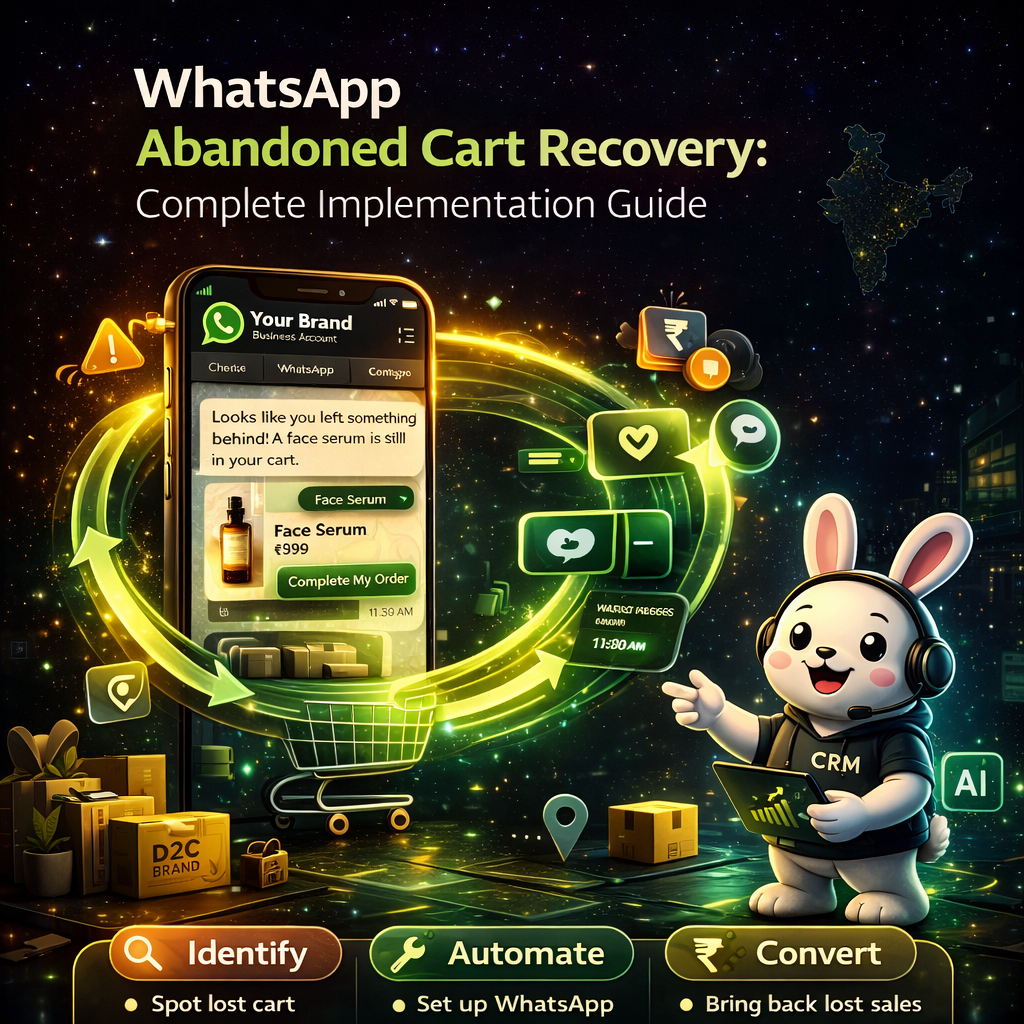
WeNext's cart recovery engine sends three messages over 48 hours. Each message has a specific job.
Message 1 — The Reminder (30–60 minutes after abandonment)
The first message is sent while the product is still fresh in the customer's mind. It is not pushy. It does not offer a discount. It simply reminds the customer that their cart is waiting, names the specific product they were looking at, and includes a direct payment link. WeNext personalises this automatically — pulling the customer's first name and the exact product they abandoned from your Shopify or WooCommerce store. This single message recovers 50–60% of all recovered carts.
Message 2 — The Trust Builder (12–24 hours later, if no purchase)
If the customer did not buy after message 1, there is likely a hesitation — about the product, the price, or the brand. Message 2 addresses this by adding a trust signal: a strong customer review, your return policy, a delivery guarantee, or a product highlight. WeNext sends this automatically after the configured delay, only if the customer has not yet completed the purchase.
Message 3 — The Final Offer (24 hours later, if still no purchase)
By message 3, this customer has seen your product twice and still has not bought. Price is now almost certainly the barrier. WeNext's final message delivers a time-limited incentive — a discount, free shipping, or a small gift — that converts a significant share of these holdouts. The offer feels exclusive because WeNext sends it only to customers who have not yet converted.
Connect your store. In WeNext, go to Integrations → Shopify or WooCommerce → Connect. WeNext immediately begins receiving abandoned cart events from your store in real time.
Create your three templates. Use WeNext's template builder to write your three recovery messages. WeNext provides starting templates for each message type, with the personalisation variables — customer name, product name, product image, price, and payment link — already built in. Submit for Meta approval directly from WeNext.
Configure your automation. In WeNext's workflow builder, set your trigger (cart abandoned for 30+ minutes without purchase), connect your three messages with the correct delays, and set the purchase condition that stops the sequence when a customer converts.
Activate. Turn the automation on. WeNext monitors every cart event from your store and handles the entire sequence automatically from that point forward.
Indian D2C brands lose significant margin to cash-on-delivery orders — higher return rates, cash handling costs, and working capital tied up in delivery cycles.
WeNext includes a COD-to-prepaid conversion flow built in. When a customer places a COD order, WeNext automatically sends a WhatsApp message offering a small incentive to switch to prepaid before the order ships — a ₹50–100 discount, free shipping, or a gift.
WeNext customers typically convert 20–35% of COD orders to prepaid through this flow alone. For a brand processing 500 COD orders per month at ₹1,200 average order value, even 25% conversion to prepaid eliminates returns worth over ₹1.5 lakh per month.
WeNext D2C customers consistently report 35–45% cart recovery rates from the three-message sequence, 20–35% COD-to-prepaid conversion from the automatic post-order flow, and 3.2× overall revenue uplift in the first 90 days across all WhatsApp automation.
A fashion D2C brand on WeNext with 2,000 monthly abandoned carts at ₹1,200 average order value recovers approximately ₹8.4–10.8 lakh in previously lost revenue every month — from automation that runs entirely without manual effort.
WeNext connects to Shopify and WooCommerce in 15 minutes. Your cart recovery sequence goes live the same day.
Q: How effective is WhatsApp cart recovery with WeNext?
WeNext customers typically recover 35–45% of their abandoned cart value through the automated three-message sequence. This significantly outperforms email cart recovery, which averages 10–15% for Indian D2C brands.
Q: How does WeNext connect to my Shopify store for cart recovery?
WeNext integrates with Shopify and WooCommerce through a one-click connection. Once connected, WeNext receives abandoned cart events automatically and triggers recovery sequences in real time — no developer or custom code required.
Q: How many messages does WeNext send in the cart recovery sequence?
Three messages over 48 hours — a reminder at 30–60 minutes, a trust-builder at 12–24 hours, and a time-limited offer at 48 hours. The sequence stops automatically when the customer completes their purchase.
Q: Can WeNext handle COD-to-prepaid conversion as well?
Yes. WeNext includes a built-in COD-to-prepaid conversion flow. WeNext customers typically convert 20–35% of COD orders to prepaid through this flow — reducing returns and improving working capital significantly.






.svg)
